Cannabis retail compliance does not pause for the travel calendar, and that creates a genuine operational headache for dispensaries sitting near state lines or airports during Thanksgiving week. Alexis 420, a free directory built from official state license lists, has published a guide sorting all 50 states and Washington, DC by whether a visitor can legally walk into a licensed store and buy something. With AAA projecting roughly 81.8 million people traveling at least 50 miles from home this Thanksgiving, most of them by car, the timing is not incidental.
Why the patchwork matters for operators, not just visitors
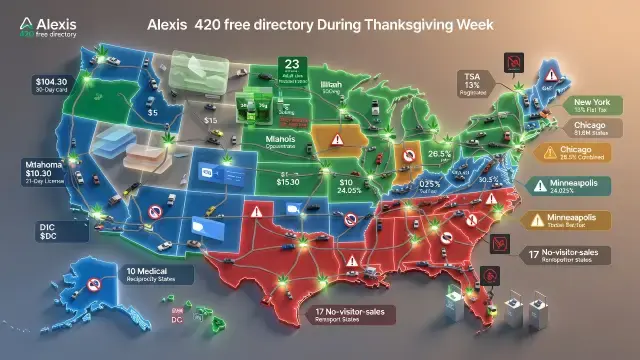
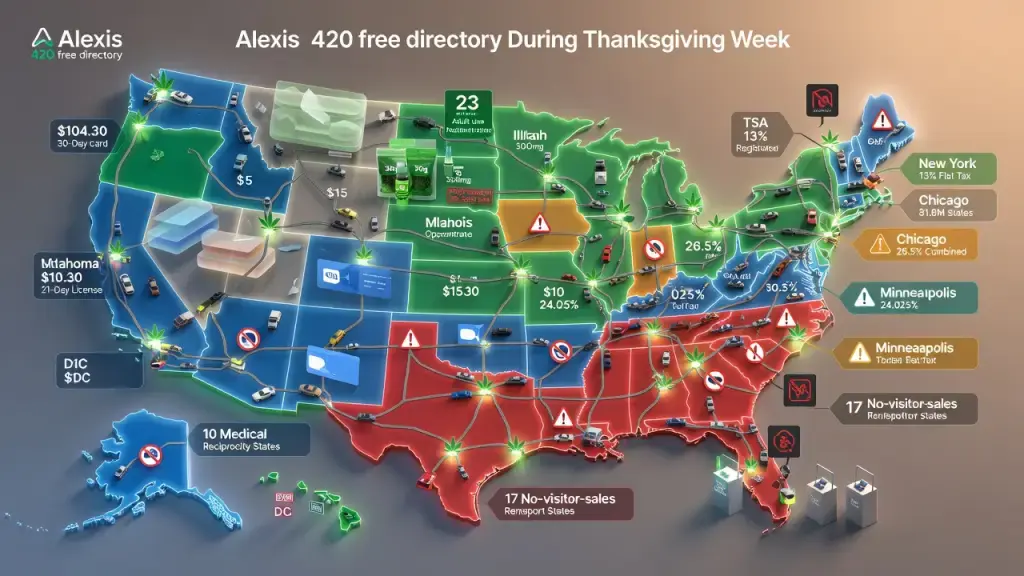
Twenty-three states sell adult-use cannabis to any visitor 21 or older with a valid government photo ID, full stop. That sounds simple. In practice, though, purchase limits still vary by jurisdiction, and a few quirks carry real compliance weight for store staff. Illinois, for instance, caps out-of-state buyers at half the resident limit - 30 grams of flower, 5 grams of concentrate, 500 milligrams of THC in edibles - which means budtenders need a reliable way to flag residency at the POS terminal, not just verify age. Ohio went further: since March 20, 2026, possessing cannabis there that wasn't purchased at an Ohio store is illegal, closing a loophole that out-of-state product used to slip through. For multi-state operators, that kind of rule isn't trivia. It's a training point, a signage point, and potentially a liability point if staff wave through a sale without checking ID origin against purchase-limit tiers.
Medical reciprocity and the fee-based workaround
Ten states plus DC allow visiting patients to buy, but only with a home-state medical card or, in a few cases, a temporary registration bought on arrival. Oklahoma's 30-day temporary license runs $104.30; Utah's 21-day card is $15. Washington, DC lets any adult 21 or older self-register online for a short-term patient registration starting at $10 for three days. These fee-based access points are worth watching as a retail trend in their own right - they function almost like a toll for market entry, and they shift compliance burden onto the visitor rather than the dispensary. Seventeen states, including Texas, Florida, and Georgia, have no licensed store selling to visitors at all. Some run tightly restricted medical programs for residents only; Virginia's adult-use stores, notably, still haven't opened, leaving a regulatory gap even where the law technically allows sales eventually.
Taxes, IDs, hours, and the cash problem
Local tax stacking is its own trap for travelers and a pricing variable operators manage constantly. New York applies a flat 13% cannabis tax with no sales tax layered on top, while Chicago's combined tax on flower at or under 35% THC runs 26.5%, and Minneapolis lands at 24.025%. Accepted ID lists differ too - California takes a passport from any country or a military ID, while Minnesota's list leaves military ID off entirely. Store hours shift by jurisdiction as well: Illinois allows locations with local approval to stay open until 2 a.m. as of June 12, 2026, while California bars sales or delivery after 10 p.m. statewide. And then there's payment. Credit cards still rarely work at dispensary POS systems because card networks avoid cannabis transactions under federal illegality, pushing most stores toward cash or debit-only models - a persistent friction point for an industry still waiting on broader cashless payment infrastructure.
Federal law still governs the car, the airport, and the sidewalk
Buying legally in one state does not make transport across a state line legal - that remains a federal offense regardless of either state's rules, a distinction many travelers misunderstand. TSA refers drugs found during screening to law enforcement, and federal land, including national parks, follows federal law regardless of state policy. Public consumption carries its own restrictions almost everywhere; New York is a rare exception, generally permitting cannabis smoking wherever tobacco smoking is allowed, with carve-outs like New York City parks and beaches. For dispensary operators, the lesson is less about tourists and more about the compliance culture their staff need to reinforce at every transaction: ID verification, purchase-limit tracking, and clear point-of-sale messaging about where product can and cannot be used once it leaves the store.