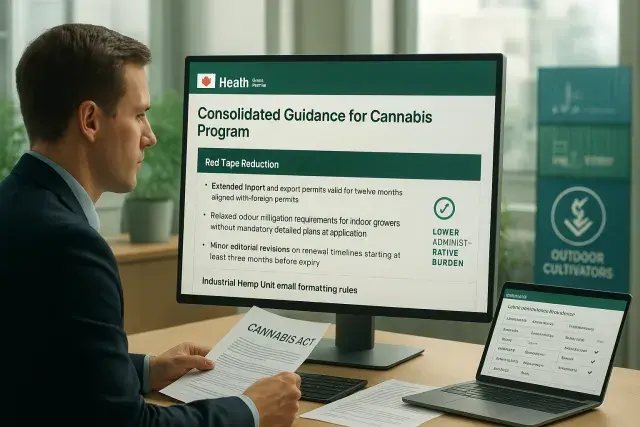
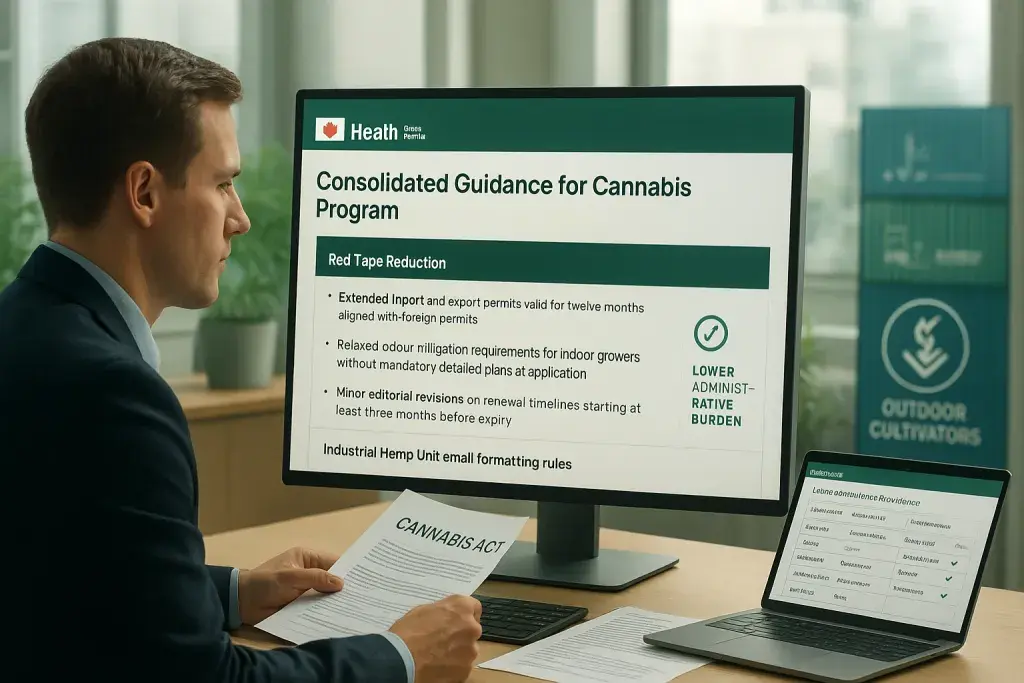
Health Canada has stood up a central online repository for cannabis program guidance documents, giving licence holders and applicants one place to track ongoing and upcoming changes tied to the agency's Red Tape Reduction initiative. The first batch of updates is modest in scope but not in consequence: two "key" changes affecting import and export permits and odour mitigation rules, plus three minor editorial revisions touching renewal timelines, hemp licensing, and intoxicating cannabinoid guidance. For an industry that has spent years navigating shifting paperwork requirements, a single repository is a small but meaningful operational win.
The first key change extends import permit validity from six months to twelve, and aligns export permit expiry with the corresponding foreign import permit. That matters more than it sounds. Import and export delays have long created bottlenecks for licence holders sourcing genetics, extracts, or finished product internationally, forcing compliance teams to renew paperwork mid-shipment or risk holding inventory in limbo. Doubling the permit window reduces that administrative churn and gives supply chain managers more breathing room to plan around customs timelines. Operators managing multiple SKUs across international suppliers will find this particularly useful when paired with cannabis compliance software that tracks permit expiry dates alongside batch records and delivery manifests. cannabis compliance software
Odour Rules Loosen, But Local Bylaws Still Apply
The second key update softens the front-end burden for odour mitigation. Applicants no longer need to submit detailed odour control plans or prove their adequacy at the application stage, though licence holders must still maintain appropriate systems in production and storage areas. Licence holders may still contact local law enforcement if they suspect illegal cultivation nearby, but that step is now optional rather than expected. Only indoor growers face the federal restriction; outdoor cultivators remain governed by whatever municipal bylaws apply. For operators near residential zones, that distinction is not academic - a lighter federal standard does not override a stricter local ordinance, and landlords or municipalities can still impose their own requirements.
Editorial Fixes With Real Compliance Weight
The three minor changes read like housekeeping, but each carries practical implications. The renewal guidance for cultivation, processing, and medical sale licences now instructs holders to start renewal "at least" three months before expiry rather than "no less than" three months - a wording tweak that removes ambiguity for compliance staff building renewal calendars. The Industrial Hemp Unit now requires applicants to include their name and the subject of correspondence, not just the application ID, in email subject lines when requesting changes - a small fix that should speed up processing for hemp licence holders. The document also reiterates that milling flowering heads into pellets requires a separate cannabis processing licence, closing a gap some hemp operators may have assumed didn't apply to them.
What This Signals for the Broader Regulatory Track
The guidance on intoxicating cannabinoids other than delta-9-THC was tightened as well. The preventive control plan language now explicitly requires identifying risks from chemical substances used in synthesis and any resulting by-products, and the word "deliberately" was dropped from the recommendation on specific controls - a change that broadens which products the guidance is meant to cover. None of this replaces the larger legislative work still pending. Structural issues like excise tax reform, marketing restrictions, or Indigenous self-government provisions require Parliament to amend the Cannabis Act itself, not just agency-level guidance. But this repository, paired with the 2025 regulatory overhaul covering licensing, packaging, and production space, suggests Health Canada intends to keep making incremental, lower-friction adjustments while the bigger legislative questions from the 2024 review - and its 54 recommendations - work through a slower process.