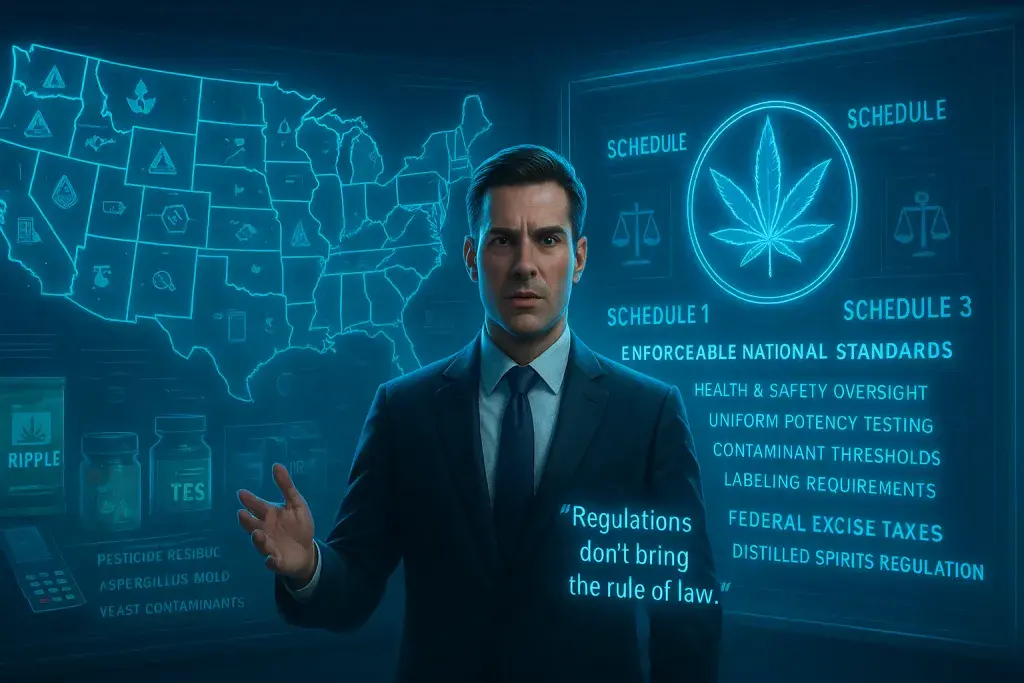
Justin Singer wants to be clear about something: moving cannabis to Schedule 3 under the Controlled Substances Act is not, by itself, progress. For the co-founder and CEO of Colorado-based Ripple Edibles, rescheduling only carries weight if it produces enforceable, nationally consistent consumer protection standards - the kind the legal cannabis market has never actually had. The distinction he draws isn't rhetorical. It cuts to a structural failure that licensed operators, dispensaries, and brands have been operating around for years.
The problem, as Singer frames it, isn't that cannabis is over-regulated. It's that the rules on the books aren't reliably enforced. States legalized cannabis independently, without the federal infrastructure to backstop meaningful health-and-safety oversight, and the result is a patchwork of requirements that shift from state to state - and frequently shift within states as legislatures and regulators revise policy. Dispensary operators in Colorado already manage some of the country's most detailed seed-to-sale compliance requirements, and many investing in the best cannabis pos systems colorado has to offer are doing so partly to keep up with those requirements - yet even rigorous recordkeeping at the point of sale can't substitute for upstream testing standards that actually hold. Singer said this inconsistency undermines consumer confidence across the entire market.
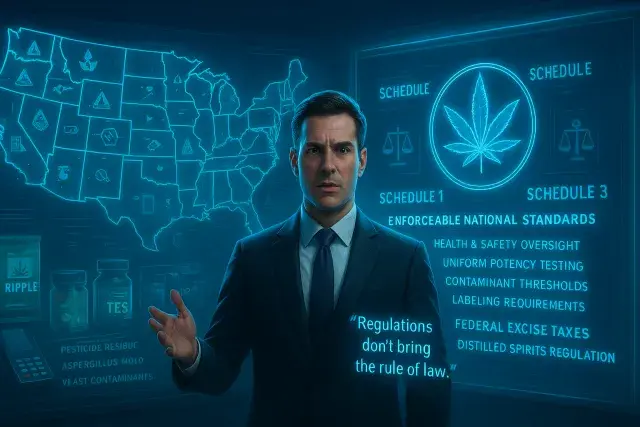
"There's a distinction between having regulations and having rule of law," Singer told MJBizDaily. "Businesses are skeptical of regulations if you don't have enforcement." His analogy is the used-car market: when buyers can't distinguish a well-maintained vehicle from a lemon, they discount everything on the lot. Singer sees that same erosion happening in cannabis retail - and he reads price compression as evidence. When prices to the consumer fall faster than the cost of manufacturing, he argues, something beyond economies of scale is driving it. Consumers are losing faith in what they're buying.
The Enforcement Gap Has Measurable Consequences
The gaps Singer describes are operational in nature. Without a single authoritative federal standard, testing methodology for THC potency varies by state. Acceptable thresholds for pesticide residues, aspergillus mold, yeast, and other contaminants aren't uniform. A compliant product in one state may not meet requirements in another - or may meet requirements on paper while the lab that issued the certificate of analysis operates under minimal oversight.
Singer backed a Colorado bill that would have moved cannabis testing lab oversight from the state Marijuana Enforcement Division to the Department of Public Health and Environment. The bill failed on April 28. That outcome matters to the broader debate: it shows how difficult it is to shift regulatory authority even within a single state, let alone build consensus across dozens of them. The institutional resistance to reorganizing cannabis oversight isn't abstract - it's a real obstacle to the kind of enforcement infrastructure Singer is describing.
"Enforcement ensures consumers are consuming what they think they're buying and that they're not smoking pesticides," he said. That's not a marketing claim. It's a compliance standard - and one that the current system does not consistently meet.
A Federal-State Division That Actually Makes Sense
Singer isn't calling for federal preemption of everything. His proposed division of authority is worth taking seriously on its own terms.
Federal jurisdiction, in his view, should cover health-and-safety standards: acceptable contaminant levels, potency testing methodology, and labeling requirements that consumers can actually rely on. Excise taxes, structured similarly to how the federal government taxes distilled spirits or beer by volume, should also be federal. That approach would eliminate the current situation where state excise tax structures vary widely, creating disparate cost burdens across markets and complicating multi-state operations.
State authority, by contrast, should govern retail - zoning, local retail taxes, marketing restrictions, and community-level exposure decisions. "Retail should be state by state," Singer said. "But the federal government needs to handle health and safety and excise taxes, and leave it to the state to handle retail taxes." That's a structurally coherent model. It mirrors, roughly, how alcohol regulation works in practice: federal standards for production safety and federal excise taxes, with state control over distribution, licensing, and retail conditions.
The thing is, that model took decades and a constitutional amendment to build for alcohol. Cannabis is trying to construct something analogous under active Schedule 1 status - or, potentially, Schedule 3 - without the same institutional foundation.
What This Means for Operators and Brands
For dispensary owners and cannabis brands, Singer's framework points to a practical business reality that often gets obscured by the policy debate. Inconsistent testing standards don't just create consumer risk - they create competitive distortion. A brand that invests in rigorous testing and clean inputs competes on the same shelf as products that cut corners, often without consumers having any way to tell the difference from a label or a budtender conversation.
Singer's own company, Ripple, hired food scientists from consumer-packaged goods backgrounds and built its product line - including a dissolvable powder, compressed tablets, and a gummy format - around consistent, measurable dosing. When raw-material costs fell, Singer said savings were passed directly to consumers rather than absorbed into margin. Whether or not a retailer carries Ripple products, that approach reflects a broader argument: that consumer trust is a business asset, and that it degrades when the regulatory environment doesn't distinguish between compliant and non-compliant products.
Regulators, in Singer's view, aren't in the industry-promotion business. "The regulator's duty is to protect consumers," he said. "My business's duty is to make money. Those are different roles and they break down when no one is enforcing them." That line should probably be posted somewhere visible in every state cannabis agency in the country. The roles are different. Conflating them - which happens often in a sector where regulators have sometimes seen themselves as stewards of market development - is where enforcement starts to slip.
Rescheduling, if it happens, will not automatically fix any of this. What it could do is open a regulatory channel for federal agencies to set enforceable baseline standards. Whether that opportunity gets used, and by whom, is the question Singer is really asking.