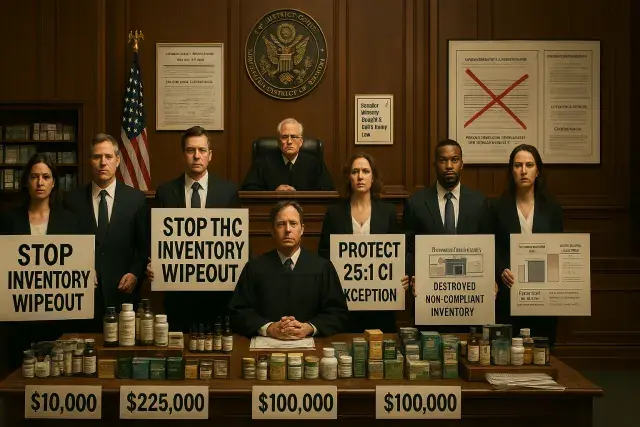
Seven Virginia hemp businesses filed suit on July 31 in the U.S. District Court for the Western District of Virginia, asking a judge to block a state budget provision that eliminates a key exception for consumable hemp products before it takes effect August 15. The plaintiffs say the change will render much of their inventory unsellable, trigger layoffs and push some companies toward closure, all within roughly 40 days of receiving formal notice.
What the Exception Actually Did
Virginia's 2023 hemp law, sponsored by then-Sen. Emmett Hanger, set a 2-mg total THC cap per package but carved out an exception: products could exceed that cap if they contained at least 25 times as much CBD as THC. That ratio allowed a category of higher-CBD, low-THC beverages and edibles to exist legally, provided they still met child-resistant packaging, lab testing, warning-label and age-21 purchase requirements. Strip out the exception, and the math simplifies brutally - total THC per package can't exceed 2 mg, full stop, regardless of how much CBD offsets it. For operators who built SKU catalogs, supply contracts and point-of-sale configurations around that ratio, the shift isn't a tweak; it's a different regulatory universe. Retailers tracking compliance across state lines already know how fast a single definitional change can ripple through inventory logs and vendor agreements, a lesson operators using something like Tennessee cannabis POS infrastructure to manage multi-jurisdiction SKUs would recognize instantly. Tennessee cannabis POS
The Business Math Behind the Lawsuit
The numbers cited in the complaint vary by company but point to the same structural problem: fixed leases, creditor obligations and trained staff don't disappear just because a product category does. District Hemp Botanicals reports roughly $10,000 in now-noncompliant inventory against more than $181,000 in outstanding obligations, and expects to terminate its Leesburg store lease. Cypress Hemp says the affected products represent about 95 percent of its revenue. Redfern Hemp estimates losses between $110,000 and $115,000, while Simply Hemp projects a roughly $225,000 revenue hit tied to closing its Collinsville location. None of that accounts for what happens to inventory that simply gets destroyed - plaintiffs say no compensation mechanism exists for product that becomes illegal to sell overnight.
A Regulatory Gap the State Wants Closed
Virginia's position isn't without grounding. Officials argue that intoxicating hemp products have spread through vape shops and convenience stores that operate outside the compliance framework governing licensed marijuana dispensaries - no seed-to-sale tracking, no equivalent enforcement teeth, no consistent age-gating at the register. The Spanberger administration frames the 25-to-1 exception as a loophole that let some sellers push products with real intoxicating effect while technically staying under a CBD-weighted formula. That's a legitimate consumer-protection concern on its face. But the plaintiffs counter that the new 2-mg standard ignores concentration, serving size and actual psychoactive effect - treating a 12-ounce beverage with 10 mg of THC spread across ten servings the same as a single-dose product with equivalent total THC. Whether that distinction holds up in court is exactly the kind of question a due-process and equal-protection challenge is built to test.
Timing Collides With the Coming Marijuana Market
Here's the catch that makes this dispute sharper than a simple compliance deadline: Virginia's adult-use marijuana retail market, under the Virginia Cannabis Control Authority, isn't scheduled to open until July 1, 2027. That leaves an eleven-month gap in which the 2-mg product category that exists today becomes illegal before any regulated alternative is available. Marijuana Justice's Chelsea Higgs Wise has pointed to this gap as a repeat of the confusion that followed Virginia's 2021 legalization of possession without a retail framework - consumers, law enforcement and local governments left guessing at implementation details. For operators, wholesalers and landlords with hemp-anchored leases, the practical question isn't just legal compliance; it's whether the state offers any wind-down period, or whether inventory simply gets destroyed with no transition and no market to pivot toward until 2027.
What Other States Suggest About the Road Ahead
Virginia isn't inventing this fight from scratch. California moved to an outright ban on detectable THC in hemp food, beverages and supplements. Minnesota chose calibrated regulation, permitting hemp beverages and edibles up to 5 mg THC per serving and 50 mg per package under testing and labeling rules. Texas went the prohibition route on delta-8 and other THC isomers after its state supreme court upheld regulators' authority to classify it as controlled. Layer in the federal picture - a funding measure signed by President Trump sets a 0.4-mg total THC limit per container for hemp-derived products starting November 12, well below even Virginia's current 2-mg standard - and operators are staring at compliance thresholds tightening from multiple directions at once. For dispensary owners, brand manufacturers and compliance teams watching this case, the outcome may shape how much runway states are required to give hemp businesses before redefining what's legal to sell.