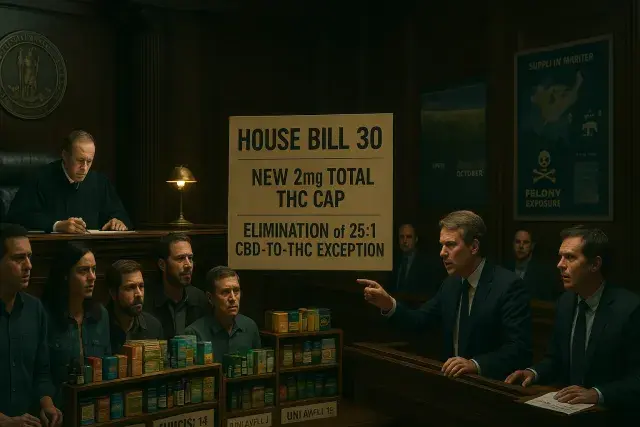
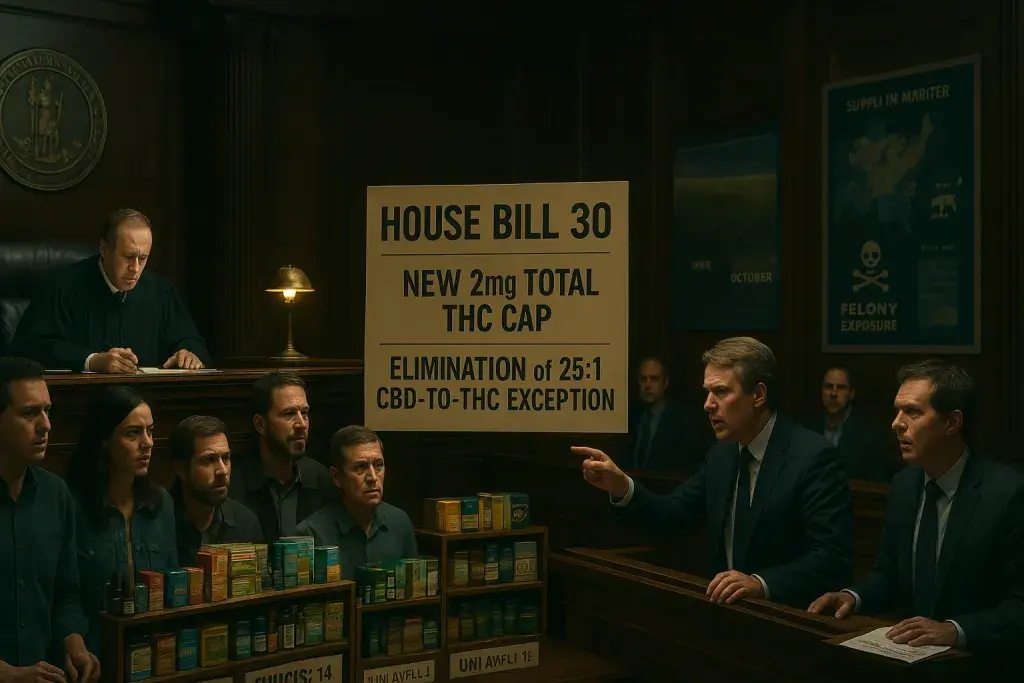
A federal judge spent nearly five hours Wednesday weighing whether to pause Virginia's new hemp restrictions before they take effect Saturday, as seven hemp businesses argued the rules would gut their inventory and put them out of business almost overnight. U.S. District Judge Robert S. Ballou heard testimony from operators who say House Bill 30 leaves them no realistic way to comply in time, and attorney Chap Petersen, who represents the plaintiffs, said he expects a decision by Friday.
The dispute centers on two provisions buried in the state budget: elimination of the 25-to-1 CBD-to-THC exception and a new two-milligram total-THC-per-package cap on most hemp products. For retailers who built compliant packaging, wholesale menus, and SKU management around the old thresholds, that is not a minor tweak - it is a rewrite of what counts as legal hemp under state law. Operators managing multi-state supply chains already know how fast a compliance framework can shift under them; the same volatility that has pushed some multi-state operators toward tighter inventory controls and platforms like cannabis pos vermont systems to track shifting THC thresholds is now landing hard on Virginia's hemp sector, only with far less runway to adjust.
Why the Timing Matters for Compliance
Petersen's central argument is not that the state lacks authority to regulate hemp-derived cannabinoids - it clearly does - but that the compressed timeline denies businesses any real chance to adjust. Governor Youngkin signed the budget June 29, putting the effective date roughly six weeks out. For an agricultural product, that is a brutal window. Hemp crops planted in April, with harvest expected around October, cannot simply be redirected once the law changes; unlike a skill-game machine that can cross state lines, a hemp plant grown for one state's market has no other buyer once it is out of the ground.
The Overnight Legality Problem
Perhaps the sharpest operational risk raised in court involves products that are fully compliant on August 14 and suddenly unlawful on August 15. Cody Moorefield, owner of Simply Hemp in Collinsville, described the scenario bluntly: inventory legal at midnight becomes a potential felony exposure hours later, with no transition period, no buyback mechanism, and no clear guidance from the state's cannabis regulatory agency on how to handle existing stock. That is the kind of compliance vacuum that keeps operators up at night - literally, in Moorefield's case - because there is no COA update or repackaging fix that resolves a THC ratio that no longer exists under the statute.
What an Injunction Would Actually Buy
Petersen is not asking Ballou to strike the law down outright. He wants a temporary injunction that keeps enforcement paused while a broader constitutional challenge - including a potential takings claim - proceeds separately, possibly to trial early next year. In practice, an injunction would give operators breathing room to sell down existing inventory, adjust wholesale relationships with Virginia manufacturers, and lobby the General Assembly for a legislative fix rather than a courtroom one. The state, for its part, maintains businesses had adequate notice. Whether Ballou agrees will determine, in the near term, whether dozens of small hemp retailers keep their doors open past this weekend.
The Broader Retail Stakes
This case sits at the intersection of hemp policy and Virginia's rollout of regulated adult-use cannabis, and it is a preview of tension other states will face as they tighten intoxicating hemp rules. Retailers, wholesalers, and landlords tied to hemp storefronts all have exposure here - not just to lost sales, but to sunk investment in compliant packaging, lab testing protocols, and point-of-sale systems built around rules that could vanish in a single legislative session. Whatever Ballou decides, the case is a reminder that hemp retail compliance is not a static checklist; it is a moving target that operators need to track as closely as any tax filing or license renewal.