
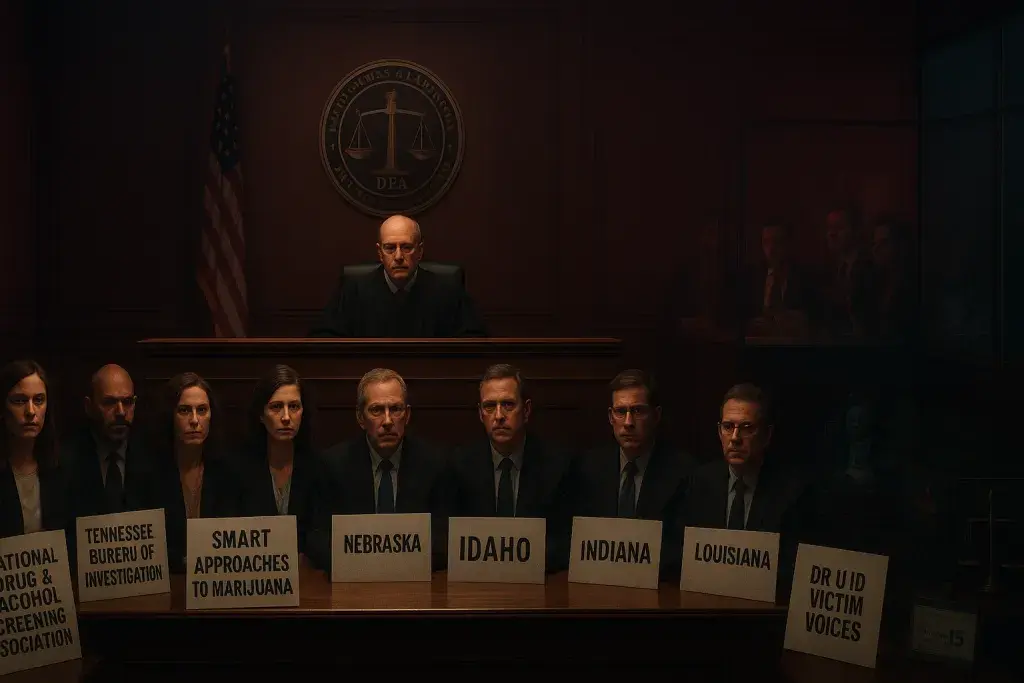
The Trump administration's approach to the DEA cannabis rescheduling hearing, set to begin June 29, has taken a sharp turn that few in the licensed cannabis industry anticipated: every designated participant selected to testify is opposed to moving cannabis from Schedule I to Schedule III under the Controlled Substances Act. Not a single pro-rescheduling entity made the list. The DEA announced its seven "interested persons" on June 18 - all of them opponents of loosening federal restrictions - leaving trade associations, cannabis businesses, and reform advocates without a seat at the table.
For licensed operators tracking federal policy - from multi-state operators managing compliance across dozens of retail locations to single-store dispensaries running cannabis point of sale vermont-style systems already built around state-specific regulatory frameworks - the composition of this hearing matters more than its procedural details. Federal scheduling status directly shapes what banks will touch, what payment rails are available, how tax liability under Section 280E is calculated, and how aggressively institutional capital engages the sector. A Schedule III outcome wouldn't dissolve those pressures overnight, but it would meaningfully shift the legal and financial architecture operators work within every day.
The seven designated participants include the National Drug & Alcohol Screening Association, the Tennessee Bureau of Investigation, Smart Approaches to Marijuana, the states of Nebraska, Idaho, Indiana and Louisiana, DUID Victim Voices, and two individual medical professionals - Kenneth Finn, M.D., and Phillip A. Drum, Pharm.D. Several of these parties, including Finn and the states of Nebraska and Indiana, recently filed lawsuits attempting to reverse Acting Attorney General Todd Blanche's April 22 order that already reclassified state-licensed medical cannabis and FDA-approved cannabis products from Schedule I to Schedule III. In other words, the same parties now designated to challenge the proposed rescheduling rule are actively litigating against the partial reclassification that already happened.
The Government Carries the Burden - Alone
Here's the structural reality that shapes everything else: the DEA is the proponent of the proposed rule, and the government carries the burden of proof. The agency must affirmatively defend moving cannabis to Schedule III - and it will do so against a room full of opponents, with no pro-rescheduling witnesses seated alongside it as designated parties. The American Trade Association for Cannabis and Hemp (ATACH), which filed a notice of intention to participate and was passed over, noted pointedly that the Trump DEA will now be solely responsible for making the affirmative case for rescheduling.
That said, the rules leave one door open. The DEA retains the authority to call its own witnesses, which could include pro-rescheduling scientific or medical experts. Whether the agency uses that authority is an open question - and a consequential one. The proposed rule itself carries forward the determination made under the previous administration's U.S. Department of Health and Human Services review: that cannabis has currently accepted medical use and that its abuse potential is lower than Schedule I and II substances. That scientific finding doesn't evaporate because the hearing roster skews one direction. But its weight in these proceedings depends heavily on how the government presents it.
A Compressed Timeline and a New Judge
The hearing is scheduled to conclude no later than July 15 - a tight window. Chief Administrative Law Judge Derek C. Julius will preside. Julius comes to the role with a background in DEA counsel work and immigration litigation, including a stint as foreign section chief in the DEA's Office of Chief Counsel from 2022 to 2024. His preliminary order was explicit on one point: the scope of this hearing excludes medical cannabis and FDA-approved cannabis products, which were already reclassified under Blanche's April order. The narrow question before the ALJ is whether the remainder of cannabis - essentially the adult-use and non-FDA-approved medical market - should move from Schedule I to Schedule III.
Each designated party gets 15 minutes for an opening statement, up to two witnesses testifying for no more than two hours each (or one witness for up to four hours), and the ability to cross-examine government witnesses for up to one hour. Interested parties cannot cross-examine one another's witnesses. Prehearing statements - capped at 25 pages - were due June 24. The structure is lean. This isn't a drawn-out proceeding; it's a fast-moving administrative process with fixed parameters and a firm end date.
What This Means for Licensed Cannabis Businesses
To put it plainly: licensed cannabis operators have no direct voice in the hearing that will shape federal scheduling policy for the product they sell, grow, and distribute. That's not a procedural technicality - it's a business risk. If the hearing produces a record dominated by prohibition-aligned testimony and the ALJ's findings reflect that record, the proposed rule faces a harder road. And if rescheduling stalls or fails, the regulatory and financial pressures that define cannabis retail - 280E tax exposure, limited banking access, restricted payment processing, difficulty securing commercial real estate - remain structurally unchanged at the federal level.
ATACH's Michael Bronstein characterized the exclusion of pro-rescheduling parties as a missed opportunity for the ALJ to hear from scientific and medical experts with direct experience in cannabis medicine and safety profiles. That's a fair concern. The hearing record, as currently constructed, will reflect the views of parties whose primary interest is maintaining or strengthening federal restrictions - not the clinical, operational, or economic experience of the licensed industry those restrictions govern.
What happens after July 15 remains to be seen. The ALJ's recommended decision will move up the chain, and the DEA administrator retains final authority. Legal challenges are already in motion from multiple directions. For dispensary operators, multi-state companies, suppliers, and compliance teams, the practical message is this: don't build your next 12 months around the assumption that Schedule III status is imminent. Watch the record. Watch the litigation. And keep your state-level compliance infrastructure solid, because that's the framework that's actually governing your business right now.