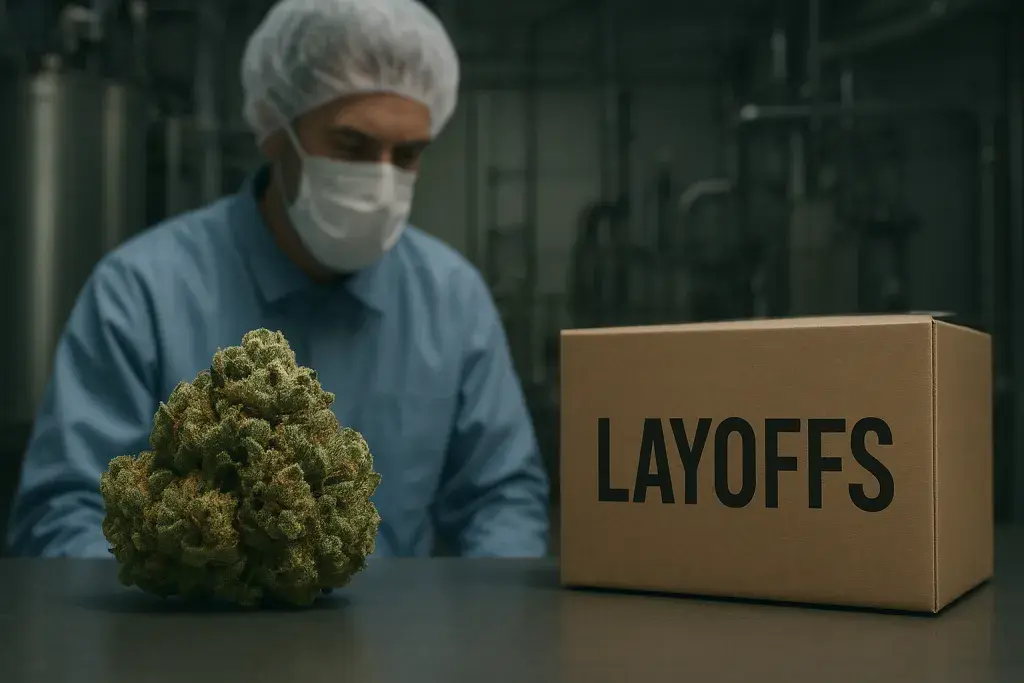
More than 100 manufacturing jobs are disappearing from Santa Rosa's cannabis sector this fall, as two separate producers file WARN Act notices tied to what one executive describes as an industry-wide "race to the bottom." CraftForce Services Inc., the manufacturing subsidiary of CannaCraft, will lay off roughly 60 workers on Sept. 20 at its Circadian Way and Giffen Avenue facilities. Days earlier, Queen City Staffing disclosed it will shutter the NorCal Cannabis Company operation on Giffen Avenue, cutting about 49 packaging and trimming positions on Sept. 13.
The overlap in geography and timing is not a coincidence so much as a symptom. Santa Rosa's cannabis manufacturing cluster grew during a period when operators bet on scale - big production floors, large headcounts, diversified SKU management across flower, vape, and edible batches. That bet assumed steady wholesale pricing and a market that would keep expanding. Neither materialized. Bret Peace, CEO of Groundwork Holding Inc., CannaCraft's parent company, put it bluntly: the business "was sized to a scale of industry that didn't materialize." Operators who once needed sprawling facilities and large production teams to track inventory across multiple product lines now find that smaller, more specialized competitors can do the same work with less overhead, often relying on a lean seed-to-sale compliance system to manage compliance logs, batch tracking, and lab testing records without the added labor cost. seed-to-sale compliance system
Why the Math Stopped Working
California's cannabis economics have been unforgiving for years, and the numbers cited in recent reporting bear that out: statewide taxable sales fell more than 12% last year, with first-quarter 2025 sales hitting a five-year low. Layer in 280E tax treatment, which bars cannabis businesses from deducting standard operating expenses at the federal level, and the margin pressure becomes structural rather than cyclical. Add persistent competition from the illicit market - unlicensed operators who skip lab testing, compliant packaging, and excise tax altogether - and licensed manufacturers are effectively competing with businesses that carry none of their cost burden.
That combination squeezes production-heavy operators hardest. Manufacturing and processing facilities carry fixed costs - rent, utilities, compliance staffing, METRC reporting obligations - that don't scale down easily when sales soften. Retail dispensaries can adjust wholesale menus and trim slow-moving batches. A manufacturer with a large workforce tied to physical production lines has fewer levers to pull short of layoffs or closure.
Local Policy Response, and Its Limits
Sonoma County has taken some steps to ease the burden. The Board of Supervisors approved a tax break in April reducing rates to $0 for qualifying operators through FY26-27, and separately created an annual licensing system with a base charge above $500 to fund the county's cannabis governance program. Fair enough as far as it goes - but tax relief and licensing reform don't fix a demand problem or reverse years of oversupply relative to sales. They buy time. Whether that time is enough for surviving operators to right-size their operations, the way CraftForce and NorCal are attempting now, remains an open question for the rest of the county's licensed cannabis employers.
What Operators Elsewhere Should Watch
For multi-state operators and California-only brands alike, these layoffs are a signal worth reading carefully.
- Production footprint should match realistic sales volume, not projected growth that assumed a larger legal market.
- Labor costs in manufacturing and trimming are increasingly vulnerable to automation and consolidation among specialized competitors.
- Union representation, present at CraftForce through UFCW Local 5 but absent at Queen City Staffing, shapes how layoffs unfold and what obligations employers face.
- Local tax relief helps cash flow but does not substitute for a functioning wholesale market.
None of this suggests the Santa Rosa cannabis sector is disappearing. It suggests a correction - a market shedding excess capacity built for a demand curve that never showed up. For dispensary buyers and wholesale partners, that likely means fewer but more consolidated manufacturing partners going forward, and a continued premium on operators who can prove compliance and consistency at lower cost.