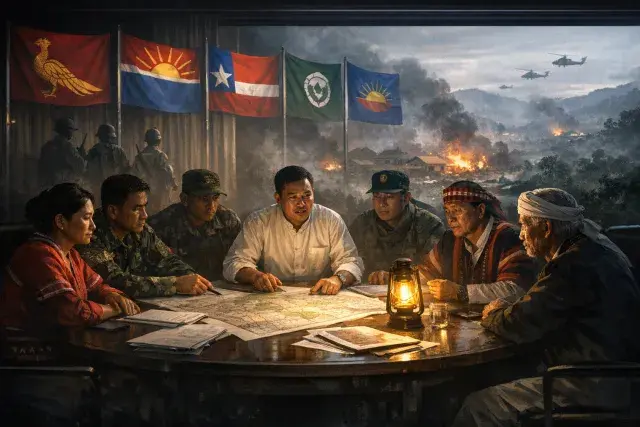
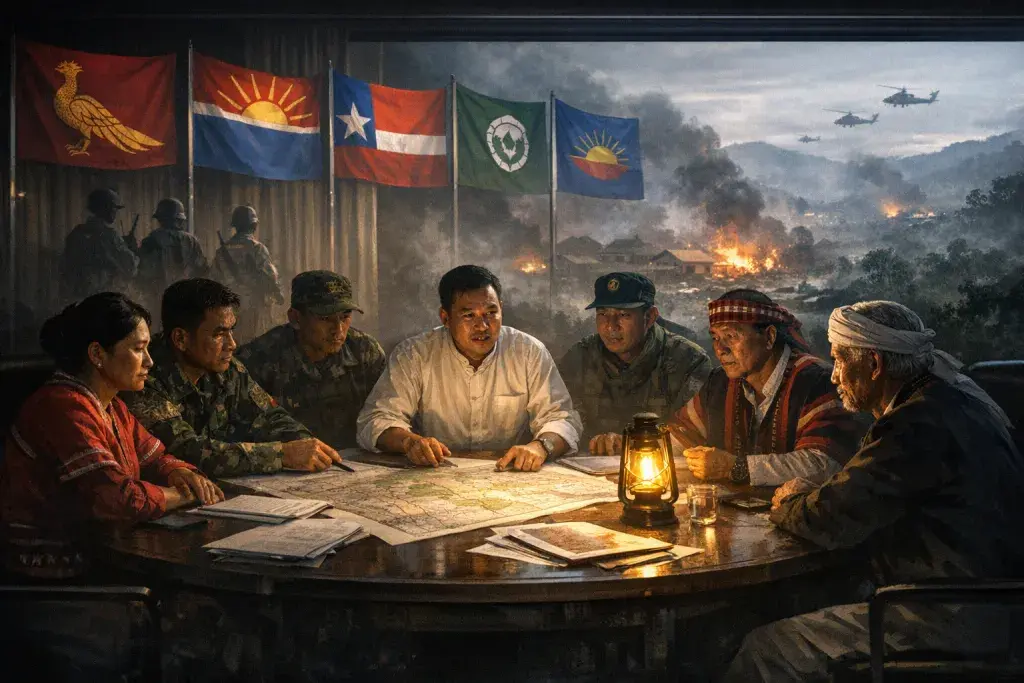
Resistance forces in Myanmar have launched the Steering Council for the Emergence of a Federal Democratic Union (SCEF), uniting the National Unity Government (NUG), the Committee Representing Pyidaungsu Hluttaw (CRPH), and four ethnic armed organizations. Announced on March 30, this coalition seeks to coordinate military and political efforts against the military junta, aiming for a swift victory and a new federal democracy. The move signals deepening alliances amid a protracted civil conflict that has displaced millions since the 2021 coup.
Coalition Foundations and Exclusions
The SCEF brings together the NUG and CRPH with the Karen National Union (KNU), Karenni National Progressive Party (KNPP), Chin National Front (CNF), and Kachin Independence Organization (KIO). These groups anchor the council on three pillars: representation from states and federal units, ethnic armed organizations and public voices, and women's groups. This structure fosters dialogue across military, political, federal, and institutional lines, addressing long-standing ethnic tensions that have fueled Myanmar's insurgencies for decades.
Absences stand out. The Arakan Army (AA) and Shan, Mon, and Pa-O groups, active in the National Unity Consultative Council (NUCC) and anti-coup efforts, stayed away. Such gaps highlight persistent rivalries among resistance factions, complicating unified action against the junta's control over central regions.
Strategic Goals and Principles
The SCEF targets an accelerated revolution to topple authoritarian rule, including the military dictatorship. Members commit to coordinating activities under legitimacy, unity, accountability, and responsible leadership. Central aims include placing all armed forces under a democratically elected civilian government, scrapping the junta-backed 2008 Constitution, and drafting a new federal democratic charter acceptable to all stakeholders.
Shared sovereignty defines the vision: power rests with the people, divided between a federal government and states or units. Political decisions emerge from collective leadership incorporating ethnic armed organizations, democratic forces, women's groups, and public representatives. A "one policy, one strategy" approach respects differences while balancing military, political, and administrative pushes, alongside partners and allies.
Implications for Myanmar's Transition
This coalition emerges from Myanmar's history of ethnic strife and failed centralization under military rule since independence in 1948. Past ceasefires crumbled amid demands for autonomy, and the 2021 coup reignited nationwide resistance. The SCEF's focus on justice for conflict victims and fair transitional courts could build trust, but success hinges on broader buy-in from excluded groups and international support.
Risks loom if coordination falters. Fragmented resistance has prolonged conflicts, allowing the junta to retain urban strongholds. Yet unified strategy might shift momentum, paving a path to federalism that resolves ethnic grievances at the core of Myanmar's instability.