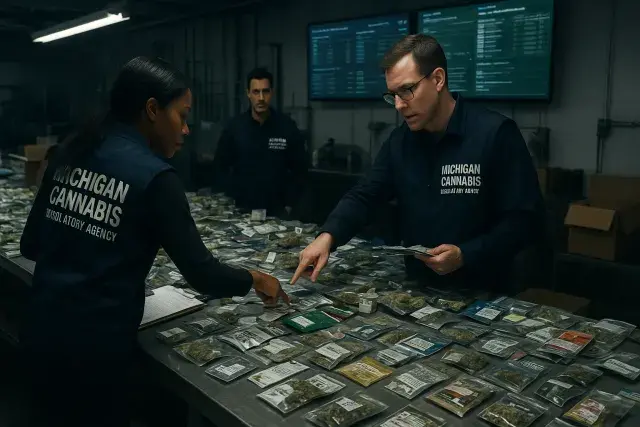
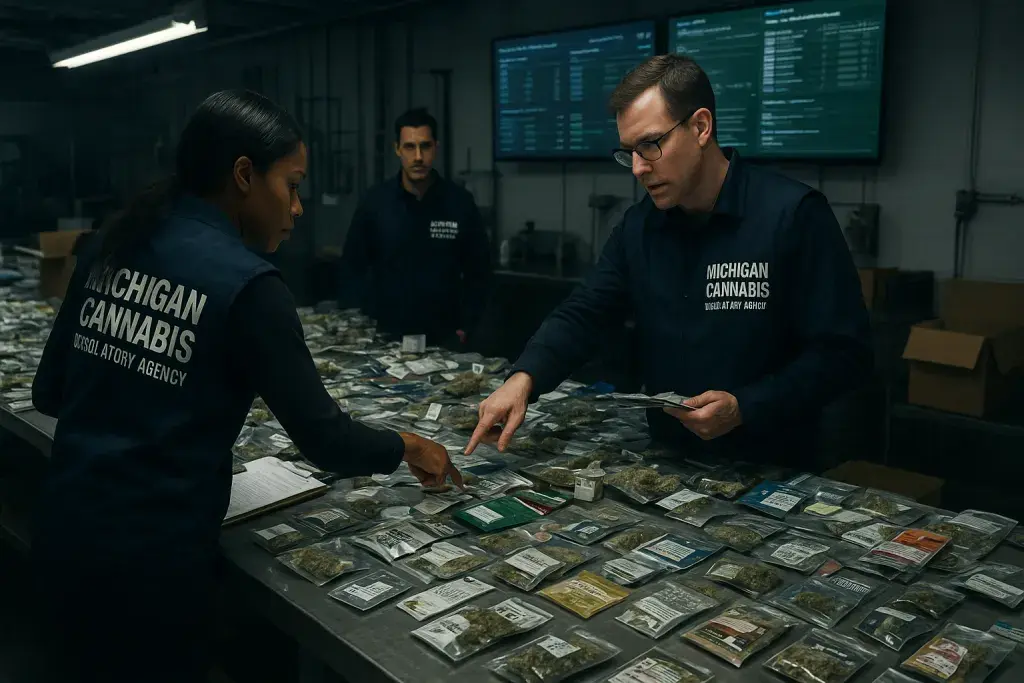
A Michigan cannabis processor is facing license jeopardy after state inspectors discovered more than 12,000 individual cannabis products with no Metrc tags, no identifying information - and among them, items packaged for the California market. The Michigan Cannabis Regulatory Agency filed a formal complaint against VJAS 1, licensed in Harrison Township, citing the untagged inventory and the presence of products bearing California-specific warning labels and "CA" designations. The company now faces potential fines, suspension, restriction, or outright revocation of its license.
What makes this case particularly striking is the combination of failures. Untagged inventory is a serious compliance lapse on its own; untagged inventory that appears to originate from another state's supply chain is something else entirely. Seed-to-sale tracking systems like Metrc exist precisely to prevent this kind of opacity. Every licensed cannabis business in Michigan - processor, retailer, cultivator - is required to tag and track product at each stage of transfer and possession. When 12,000 units can't be accounted for, that's not a clerical error. That's a systemic breakdown, or worse. Operators in other states investing in robust back-office systems - those evaluating cannabis dispensary software arizona tools, for instance - tend to do so precisely because inventory reconciliation failures carry this kind of regulatory exposure, regardless of which state you operate in.
Investigators also found products that did carry proper Metrc tags - but when cross-referenced against the statewide tracking system, those products were supposed to be at other licensed cannabis businesses. That detail matters. It suggests the compliance breakdown here isn't limited to missing tags. Products with valid tags, belonging to other licensees, sitting at a facility where they shouldn't be, raises questions about chain of custody, diversion, and whether those other businesses even know inventory is missing from their records.
Why Metrc Integrity Is the Floor, Not the Ceiling
Metrc - the third-party seed-to-sale platform used by Michigan and more than two dozen other state cannabis programs - functions as the regulatory backbone of licensed cannabis commerce. Every batch transfer, every wholesale transaction, every retail sale is supposed to generate a corresponding tag and log entry. When a facility's physical inventory doesn't match what Metrc says should be there, regulators have grounds to question everything: sourcing, sales records, tax filings, and lab-testing chains of custody.
The presence of California-packaged products is a separate and sharper problem. Compliant packaging in licensed cannabis markets is state-specific by design. California requires its own warning language, labeling formats, and child-resistant packaging standards - none of which align with Michigan requirements. Products in California retail packaging have no legitimate pathway into a Michigan-licensed processor's inventory. Full stop. The only plausible explanations are either that product crossed state lines - which would implicate federal law - or that someone sourced illicit-market goods and the California packaging is incidental. Neither scenario is good.
What Employees Said - and Didn't
The CRA noted that employees at the facility were unable to explain why or how so many untagged products were on site. That's a detail worth sitting with. In a compliant cannabis operation, every staff member handling inventory should be able to account for what they're touching, where it came from, and where it's going. That's not an advanced operational standard - it's baseline. Compliance training, intake procedures, and inventory management protocols exist so that any employee on any shift can answer those exact questions. When they can't, it usually means those protocols were either absent, ignored, or deliberately circumvented.
For other licensed operators in Michigan and beyond, the operational lesson is straightforward: Metrc compliance can't live only in the software. It has to be embedded in physical intake workflows - every delivery checked against manifests, every product tagged before it touches a shelf or production line, every discrepancy flagged and documented immediately. Automated inventory reconciliation and POS-integrated tracking help, but human accountability at the point of receipt is what keeps the system honest.
License Risk and Broader Industry Implications
VJAS 1 faces a range of enforcement outcomes: fines, suspension, license restriction, refusal of renewal, or full revocation. Michigan's CRA has broad discretion in structuring penalties, and cases involving apparent out-of-state product are treated with particular severity - because they implicate not just one operator's compliance, but the credibility of the state's regulatory program as a whole.
For the industry, this case is a useful reminder that enforcement isn't theoretical. Regulators inspect. Inspectors cross-reference Metrc. Discrepancies generate complaints. And complaints of this scale - five-figure untagged inventory, apparent cross-state sourcing - tend to end licensing relationships, not just produce fines. Operators running lean compliance programs, relying on manual processes, or skipping routine internal audits are carrying risk they may not be pricing correctly. The cost of a robust inventory system is fixed and known. The cost of a license revocation is not.