
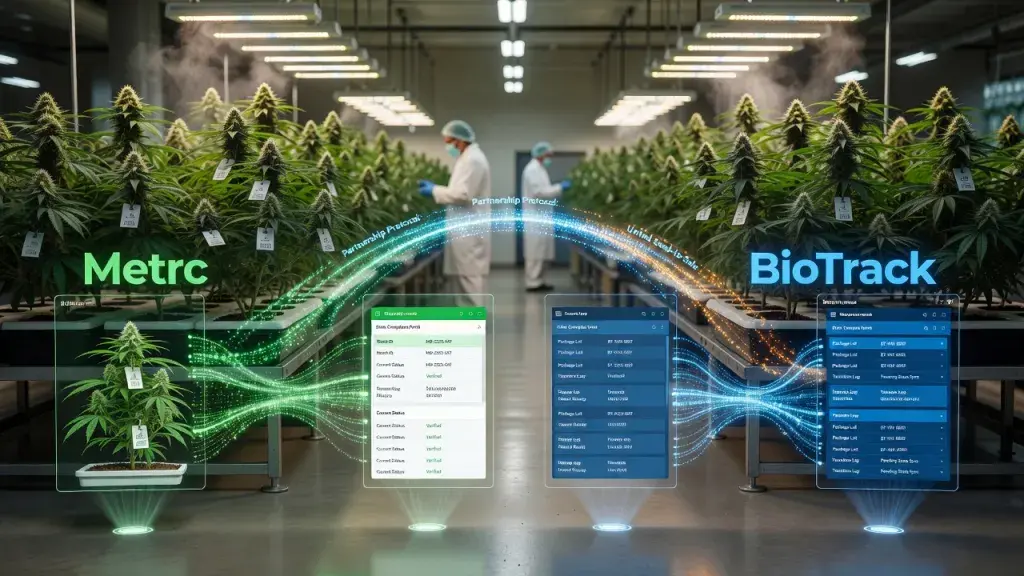
Every licensed cannabis operator in North America answers to one of two seed-to-sale tracking systems: Metrc or BioTrack. A 2025 partnership between the two companies has some operators wondering whether their compliance stack is about to change overnight. It isn't a merger, and for most businesses, day-to-day operations stay exactly the same - unless your state happens to be mid-transition.
Two Systems, Same Regulatory Job
Metrc, the more widely deployed platform, tags plants and packages with RFID chips and feeds that data to a state-run portal in real time. BioTrack runs on the same basic premise but with its own software architecture and data setup. Operators rarely get a say in which one they use. Licensing comes with a mandated system attached, full stop. The debate over which platform is "better" misses the point, since choice was never on the table to begin with.
Where the Friction Actually Shows Up
The real differences surface in the mechanics. APIs behave differently - rate limits, error handling, documentation quality all vary - which matters enormously if you're vetting a POS or ERP vendor. A vendor claiming to "support" a system and one that's "integrated reliably a hundred times" are making two very different promises. Tagging and packaging workflows differ too, enough that staff trained on one platform need real retraining before touching the other. For multi-state operators running a Metrc facility here and a BioTrack facility there, standardizing procedures across both takes deliberate work - it doesn't happen automatically just because both are labeled "compliance software." And states customize on top of the base platform anyway, tweaking reporting rules and data fields, so experience in one Metrc state doesn't fully transfer to another.
What the Partnership Does and Doesn't Mean
The Metrc-BioTrack arrangement covers data sharing between the two systems, mostly to support states currently switching platforms or wanting better cross-system verification. New York's experience - pausing an earlier plan before moving forward with a significant system switch - is the kind of scenario this partnership is built around. For operators not in a transitioning state, this changes little. For those who are, the migration itself is the risk, not the software brand behind it.
Why Migrations Are the Real Danger Zone
A state-mandated system switch is not just a software update. It's an operational event with several moving parts, and trade coverage tends to underplay this part:
- Master data cleanup - every active product, batch, and package record has to map accurately from the old system to the new one, and messy records surface fast once migration starts
- Staff retraining across cultivation tagging, transfer paperwork, POS integration, and manufacturing batch records
- A tested rollback plan, since migrations can surface data conflicts that only appear under real transaction volume
- Vendor readiness - POS, ERP, and every connected system need updated links and often updated internal logic, which depends on vendors being ready on your timeline, not just you
Neither platform deserves to be treated as background noise. Whichever system an operator runs should get the same operational attention as accounting software or lab testing protocols - because a sloppy migration doesn't just cost time, it risks compliance gaps that regulators notice. Clean data, real training, coordinated vendors, and a rollback plan are what separate a routine system switch from a multi-week operational headache.