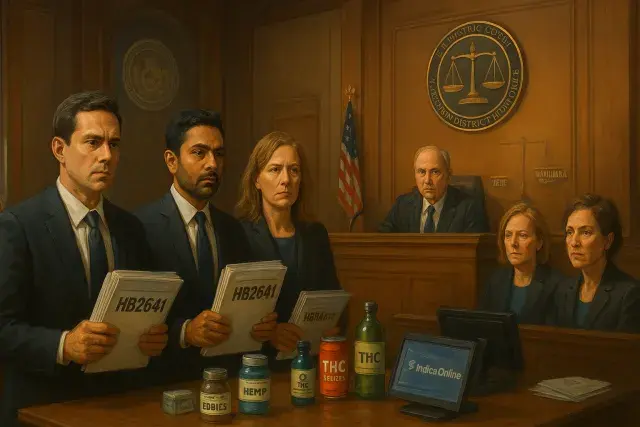
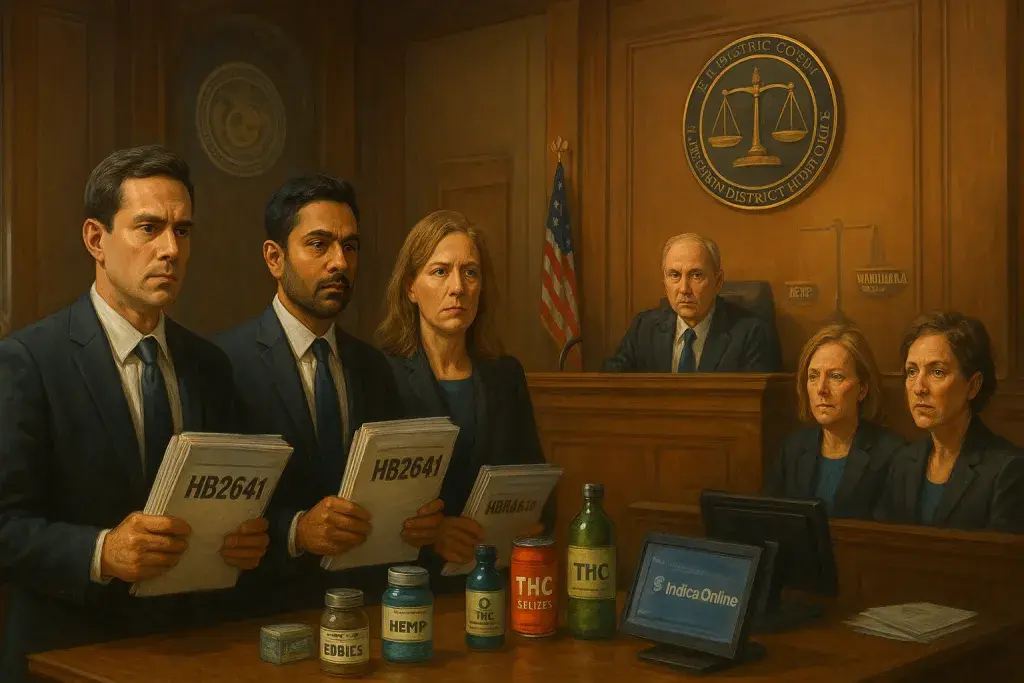
A coalition of Missouri hemp businesses went to federal court Thursday to stop a statewide ban on intoxicating hemp products from taking effect November 12. The lawsuit, filed in the U.S. District Court for the Western District, argues that legislation signed by Gov. Mike Kehoe this spring uses definitions so contradictory and vague they leave businesses, prosecutors, and law enforcement unable to determine what is actually legal - and what carries criminal penalties.
The coalition - which includes MNG 2005, Inc., parent company of the 55-store CBD Kratom chain, the Missouri Hemp Trade Association, and Wisconsin-based Lifted Liquids Inc. - is asking the court to halt enforcement of HB2641 before it reshapes the shelf inventory of thousands of retail locations. The compliance challenge here isn't abstract. Point-of-sale operators and retail technology vendors serving multi-state retailers, including solutions like IndicaOnline POS Colorado, understand that vague statutory definitions create real-world inventory and compliance problems: if the legal status of a SKU is genuinely ambiguous, operators can't program product rules, flag compliant batches, or train floor staff with any confidence. Missouri's bill, the coalition argues, creates exactly that kind of ambiguity - at scale, and with criminal exposure attached.
The core legal complaint is specific: HB2641 allegedly defines the same products as both "hemp" and "marijuana" in different provisions of the same statute. That's not a minor drafting quirk. Under Missouri law, unlicensed marijuana activity is a crime. So if a retailer stocks a THC seltzer that qualifies as hemp under one section of the bill and marijuana under another, the operator faces potential criminal liability depending on which definition a prosecutor chooses to apply. Craig Katz, government relations and compliance manager for MNG, was direct about the source of the problem. "A lot of this stuff is kind of in the weeds," he said. "When people are trying to legislate it, if they don't understand it, you come up with something like HB2641, which doesn't make a whole heck of a lot of sense."
What the Legislation Actually Does - and What the Coalition Objects To
HB2641 is not a narrow measure. It pulls all intoxicating hemp products off Missouri retail shelves starting November 12, including THC-infused beverages currently sold legally in bars and grocery stores. The bill aligns state law with the federal ban Congress approved last year - but it layers in additional state-specific provisions that the coalition says go further and cause more confusion than the federal framework.
Here's the catch: even if Congress reverses course on the federal ban, Missouri's bill would only permit intoxicating hemp products inside licensed marijuana dispensaries. That's a direct channel restriction with major commercial implications for the hemp supply chain. Businesses that have built wholesale relationships with general retail accounts - grocery chains, convenience stores, bars - would lose those distribution pathways entirely, redirected into the licensed cannabis channel where dispensary operators control the shelf and carry their own regulatory overhead.
And if Congress delays the federal ban by a couple of years, Missouri's law would still prohibit all intoxicating hemp products except beverages. That conditional structure - tiered outcomes depending on federal action that hasn't yet occurred - is precisely the kind of legislative design the coalition describes as "so convoluted that businesses cannot determine which products are covered or when."
The bill also restricts who may transport hemp products through Missouri, which the coalition argues conflicts with federal protections for interstate hemp commerce. That's a commerce clause argument that federal courts have engaged with in hemp litigation before, and it may carry more weight than the vagueness claims alone.
The Enforcement Structure Adds Its Own Layer of Risk
Missouri Attorney General Catherine Hanaway is named as the primary enforcement authority under HB2641. She's also a named defendant in the lawsuit, along with Gov. Kehoe and Sarah Wilson, director of the Missouri Department of Health and Senior Services, which oversees the state's licensed marijuana program. Hanaway's office said it had not yet been served the complaint. Kehoe's office and DHSS declined to comment on pending litigation.
Rep. Dave Hinman, the bill's sponsor, was candid about what he believes the lawsuit represents. "I believe this is the last ditch effort for the hemp industry," Hinman said. "HB2641 passed the Missouri House, Senate and was signed by the governor. It was vetted throughout the entire process." He added that he expects Missouri to mirror federal enforcement posture after November 12 regardless of the legal challenge.
That framing matters for licensed marijuana dispensary operators watching this case. If the ban holds and hemp products are restricted to licensed dispensaries, the competitive dynamic inside those stores shifts. Operators who have built compliant inventory systems, maintained seed-to-sale tracking, and absorbed the cost of Missouri's regulatory framework would suddenly share shelf space with a product category - intoxicating hemp beverages and edibles - that previously competed against them outside the licensed channel. That's not necessarily a windfall; it comes with additional compliance obligations, product testing requirements, and SKU management complexity.
The Broader Stakes for Hemp Retailers and the Licensed Cannabis Market
What's striking here is the scale of potential disruption. The Missouri Hemp Trade Association's president, Jay Patel, framed the bill in pointed terms: "This isn't consumer protection. It's the elimination of an entire legal industry coupled with a government-mandated monopoly." That's the association's position, not a neutral legal finding - but the underlying business argument deserves examination on its own terms.
Intoxicating hemp products, sold outside the licensed cannabis framework, have operated in a regulatory gray zone since the 2018 federal Farm Bill broadly defined hemp as cannabis with less than 0.3% delta-9 THC by dry weight. The resulting market includes products with significant total THC - the coalition's press release notes that products with as much as 1,000 mg of THC are currently sold in Missouri smoke shops, outside any dispensary licensing structure. That's a consumer safety and product oversight problem that state regulators have legitimate standing to address. The legal question is whether Missouri's chosen mechanism to address it is constitutionally sound.
For compliance professionals, the lawsuit is worth tracking closely - not just in Missouri. Similar legislation has moved through multiple state legislatures, and the constitutional questions the coalition is raising around definitional clarity and interstate commerce aren't unique to one state's bill. If the Western District grants a preliminary injunction, the reasoning could inform litigation strategy elsewhere. If it doesn't, November 12 becomes a hard deadline for Missouri hemp retailers to either clear intoxicating inventory or face enforcement exposure from an attorney general's office that now has explicit statutory authority to act.
Either way, the regulated cannabis industry - dispensary operators, compliance managers, wholesale distributors, and retail technology vendors alike - should be watching this one. The outcome will shape how hemp and marijuana products are defined, distributed, and taxed in one of the country's larger state markets, and it signals where the next front of hemp regulation battles may land.