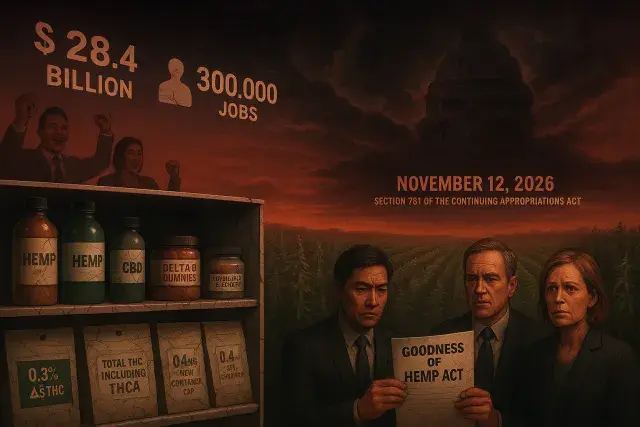
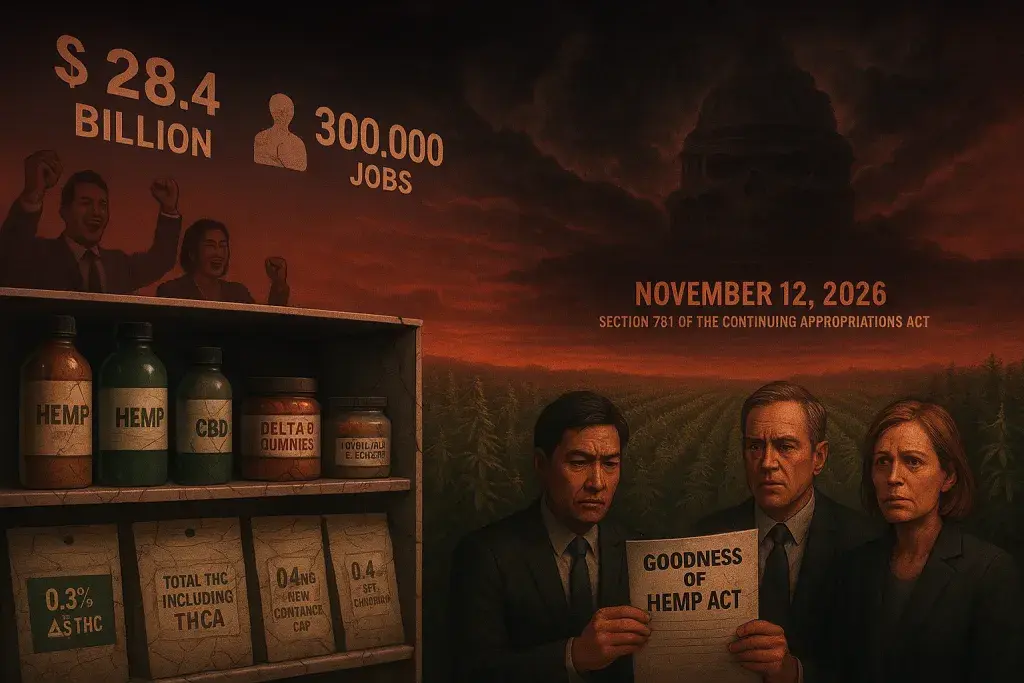
A $28.4 billion industry supporting more than 300,000 American jobs has roughly eighteen months to convince Congress to rewrite federal law-or watch a significant share of its product catalog become a Schedule I controlled substance. On November 12, 2026, Section 781 of the Continuing Appropriations Act takes effect, fundamentally redefining what qualifies as legal hemp under federal law. The changes are sweeping enough that products currently sold lawfully on retail shelves-including hemp-infused beverages, full-spectrum CBD products, and a range of hemp-derived cannabinoids-may no longer clear the new legal threshold.
The 2018 Farm Bill defined hemp by a single metric: delta-9 THC content capped at 0.3% on a dry-weight basis. Section 781 scraps that framework and replaces it with three structural changes that reshape the entire compliance picture. First, the definition shifts from delta-9 THC alone to "total THC," which adds THCA-a non-psychoactive precursor that converts to delta-9 THC when heated-into the calculation. Many full-spectrum products that sailed through lab testing under the old standard will likely fail under the new one. Second, the law imposes a hard cap of 0.4 milligrams of total THC per container, not per serving-a distinction with enormous consequences for beverage and edible manufacturers. Third, cannabinoids "synthesized or manufactured outside the plant" are prohibited outright, targeting the delta-8, delta-10, and HHC products that drove much of the intoxicating hemp market's growth. For operators trying to map their current SKU catalog against the incoming rules, you can read more about how state-level regulatory frameworks are already grappling with cannabinoid compliance across different retail environments.
Here's the catch: the 0.4 mg per-container cap doesn't just clip the edges of the intoxicating hemp market. It potentially eliminates products that responsible manufacturers have built compliant businesses around. A 12-ounce hemp beverage containing 10 milligrams of hemp extract could be perfectly legal under the current Farm Bill-and flatly illegal under the new rule-not because anything changed about the product, but because the measurement standard changed beneath it. Howard Lee, CEO of SōRSE Technology, says his company could lose 50% of its business and be forced to cut half its staff if Congress doesn't modify the law. "The idea that this will simply get rid of 'gas station weed' is misguided," Lee said. "It will embolden bad actors while shutting down the companies that follow conventional rules."
A Divided Industry, A Complicated Political Calculation
The cannabis industry isn't speaking with one voice here, and that political fracture matters. Licensed cannabis operators in adult-use and medical states have long complained that the intoxicating hemp market operates as an unregulated parallel economy-one not subject to the excise taxes, seed-to-sale tracking requirements, lab testing mandates, compliant packaging rules, or license caps that govern their own operations. From a dispensary operator's perspective, a hemp-derived delta-8 gummy sold at a gas station with no COA requirement and no age-gating represents straightforward regulatory arbitrage. That asymmetry has real consequences for wholesale pricing, retail margins, and the value of state cannabis licenses.
Hemp farmers, manufacturers, and reform advocates see the picture differently-and not without reason. Geoff Whaling, chairman of the National Hemp Association, put it plainly: "Everyone agrees that intoxicating, synthetic, converted, mislabeled, and youth-targeted products must be removed from the marketplace. The problem is that the current federal restrictions go much further and risk sweeping in legitimate hemp businesses that are already operating under state licensing, testing, labeling, age-gating, and federal agricultural rules." The concern isn't theoretical. Morgan Tweet, Co-Founder of IND HEMP and Executive Director of The Hemp Feed Coalition, says compliant operators are already pulling back-delaying hiring, reducing capital investment, and building cash reserves rather than building capacity. "The companies most affected won't necessarily be the bad actors," Tweet said. "They'll be the responsible operators that have invested in manufacturing, employees, compliance, and recognizable brands."
What the Goodness of Hemp Act Proposes
The industry's preferred legislative response is the Goodness of Hemp Act, a draft framework that would replace Section 781's blunt instrument with a tiered regulatory structure. The proposal draws a meaningful distinction between industrial hemp, CBD wellness products, and low-dose hemp beverages-assigning regulatory oversight to USDA, FDA, and the Alcohol and Tobacco Tax and Trade Bureau depending on the product category. That alcohol-regulatory model is significant; it mirrors how the beverage alcohol industry operates and would give hemp beverages a compliance pathway that doesn't require them to meet pharmaceutical-grade standards or agricultural commodity rules that weren't designed for consumer packaged goods.
The draft legislation would set a 3.7 milligram THC per serving interim limit, derived from Johns Hopkins University research on THC impairment thresholds-a data-anchored standard that gives manufacturers something concrete to formulate against. It would also establish federal requirements for testing, labeling, product registration, and age restrictions. Importantly, the framework doesn't ignore the intoxicating hemp problem that drove the original restrictions: synthetic and chemically converted cannabinoids would face significant new constraints. The legislation also addresses industrial hemp more broadly, including provisions to expand animal feed opportunities, create a USDA Office of Hemp, and support market development and research-a recognition that the supply chain damage from November 12 wouldn't stop at cannabinoids. As Whaling noted, it would chill investment across grain, fiber, food, textiles, construction materials, and advanced manufacturing.
The Legislative Clock and What Operators Should Watch
Congress has two identified vehicles before the deadline. The Hemp Planting Predictability Act, introduced by Representatives Jim Baird (R-IN) and Angie Craig (D-MN), would delay implementation by two years-to November 12, 2028-buying time for a permanent framework. A separate bipartisan bill would allow states to opt out of the federal hemp THC ban entirely. Neither has passed. And Whaling's observation about capital deserves weight here: "Capital does not like chaos. Farmers do not plant into uncertainty. Manufacturers do not build facilities without rules." That's not a political argument-it's a supply chain reality that every operator sourcing hemp-derived ingredients is already navigating.
For businesses in the hemp supply chain, the immediate operational question isn't whether to support one legislative path over another. It's whether current product formulations will survive the transition intact, what reformulation timelines look like against a November 2026 deadline, and whether brand equity built around full-spectrum or hemp-derived products can be preserved under a narrower legal definition. If Congress doesn't act, companies will face a binary choice: reformulate to meet the 0.4 mg per-container cap or exit the market. Tweet raised a harder downstream concern-if domestic producers can't meet consumer demand under the new rules, sourcing shifts overseas, taking agricultural investment and manufacturing jobs with it. The 2018 Farm Bill left the regulatory architecture unfinished. Congress now has a fixed deadline to complete the work-or let the clock run out on an industry it spent years building.